Reported by:
Heidi Tan Zhi-Qi Jr2Z(3)
Photos provided by:
Teh Zhao Xiang
~ Dazzling and Inspiring: Top Achievers of Kuen Cheng (Part 1) ~
“Fear will always exist. What matters is if you choose to overcome it now, or to leave it for later.”
These are the powerful words spoken by Teh Zhao Xiang, an alumnus of Kuen Cheng High School and a living example of how hard work and dedication will eventually lead to success. For many, standing on a stage to talk is somewhat of a challenge filled with nervousness; yet for the speaker who soon rose to become an Asia-Pacific Public Speaking champion and a seasoned TEDx Asia speaker, nervousness is not something one can easily remove, but rather a feeling one must learn to overcome. His inspiring journey from first stepping onto the stage to bagging the champion title was not one of easy success, but a strenuous path of constant practise, shifting mindsets, and the courage to push beyond limits.
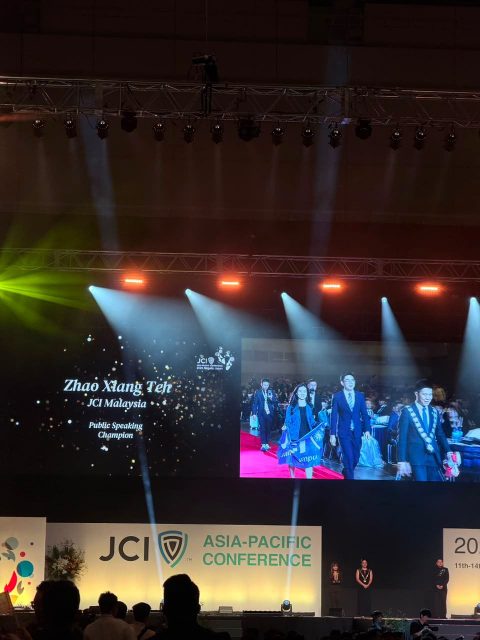
(Photo 1: Zhao Xiang being introduced on stage under beaming spotlights)
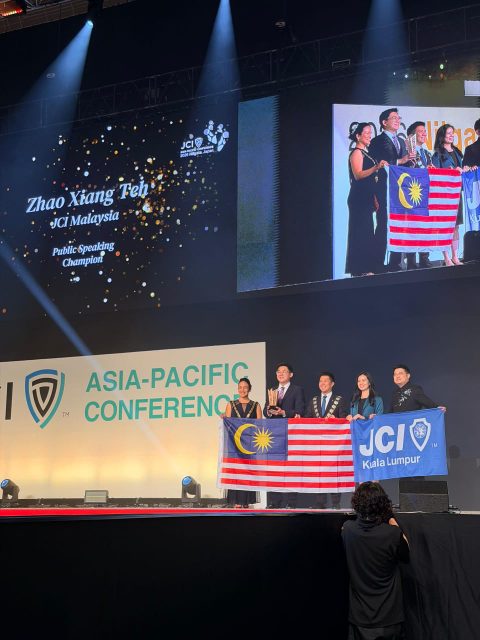
(Photo 2: Zhao Xiang receiving the award on stage with the Malaysian flag)
The Start of a Remarkable Journey
Zhao Xiang first started to compete in public speaking at the ripe age of 18, being recommended for an in-school competition by his English teacher. Having been recommended once when he was 16, he turned the offer down because he partly did not have enough practise time and lacked confidence. When the opportunity came again, he decided to give it a shot—unbeknownst to him, his decision would eventually lead him to a much larger stage.
Whilst preparing for major competitions, he did not solely focus on certain skills and delivery. Instead, before practising, he would ask himself: “What is the purpose of this speech?’’ Every speech should carry a clear message; pronunciation, tone, and body language are secondary skills that can be further improved later on. Only after clarifying the core message and purpose do the rest of the techniques come into use. He also studied recordings from the Toastmasters Annual Public Speaking World Championships to learn from top champions.
Beyond the Championship Title
The Asia-Pacific championship concurrently remains his best performance and highest achievement to date. Upon clinching victory in the preliminary round of the competition, he did not feel the sense of joy as he thought he would—instead, he felt a strong sense of urgency. Winning would mean he would have to now compete against top speakers around the world in the finals. In lieu of celebrating for long, he quickly diverted his attention towards preparing for the greater challenge.
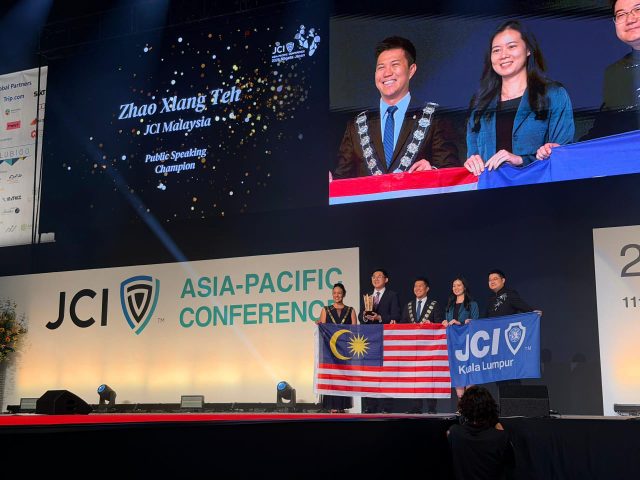
(Photo 3: Glorious award ceremony moment at the Asia-Pacific Conference)
Regarding his cause of pressure before the competition, he highlighted that most pressure comes from one’s own expectations, not from others. When under a high-stakes situation, one can only handle so much; having a mentor, coach, or basically a support person is extremely vital. Just ten minutes before speaking, when a former Malaysian champion offered help, he initially refused but gave in in the end and soon heard valuable feedback. He then changed nearly half of his speech on the spot based on the advice, learning that accepting guidance is never a sign of weakness.
Style, Connection, and Listening
He also pointed out that no one is born with a perfect personal speaking style, so speakers tend to develop their own style through speaking and practicing. An authentic speaking style only forms through deep study, constant practice, observing and experimenting with different styles. He learned from different speakers, experimenting with new approaches, and eventually finding his own style. Imitation is never about becoming someone else— it is rather about discovering what works for you.
A truly memorable speech is not just about reciting words perfectly as though reciting from a script; what truly matters is the energy you share, the atmosphere you create and the genuine connection you share with listeners. The audience can sense every single thing down to your emotions and feelings, so speaking with sincerity always matters more than seemingly appearing flawless.
To connect deeply, you must first learn to listen before you learn to speak. Before you express your own ideas or find your own unique voice, listen to different speakers and absorb diverse perspectives from others. He applies this same principle in his work: before speaking or recommending anything, he will first listen and assess what the other party truly needs. Public speaking is not a skill reserved for only on stage; it is an ability that improves communication in daily life.
Speaking, Leadership, and Growth
On the topic of how public speaking can help someone to become a better leader, he emphasised that speaking abilities and leadership skills are closely related and can strengthen each other. Leaders must speak clearly and confidently so that others can trust and understand their vision. He also applied these skills while serving as a President of the Boy Scout troop. All in all, public speaking can improve one’s communication skills and help one learn how to bring leadership and confidence into every conversation, not only when standing on stage.
His advice for students is not to fear imperfection, as over 60 per cent of students avoid public speaking because they fear making mistakes and being judged. Another worry of students is language limitations. Language limitations are never a true barrier, it is rather the uneasiness you impose on yourself. Public speaking is never about using fancy or bombastic words in your speech; it is simply about making yourself understood. Nervousness and excitement feel very similar, so change your mindset and choose how you want to view that feeling: as motivation or fear.
Face Fear Now, Rather Than Later
Fear will not vanish simply just because you want to avoid it; more challenges will always come. So instead of waiting until you feel brave enough, seize the day and start training yourself to face fear now. Competing is also not only about winning prizes and gaining experience— it is about how early you are willing to try and give it a shot. From getting the chance to stand on the Asia-Pacific stage, his journey shows that growth does not only come from a single victory, but from choosing to move forward despite great adversities, nerves, pressure and uncertainty. Fear may always exist, but it is you who decides when to begin facing it.
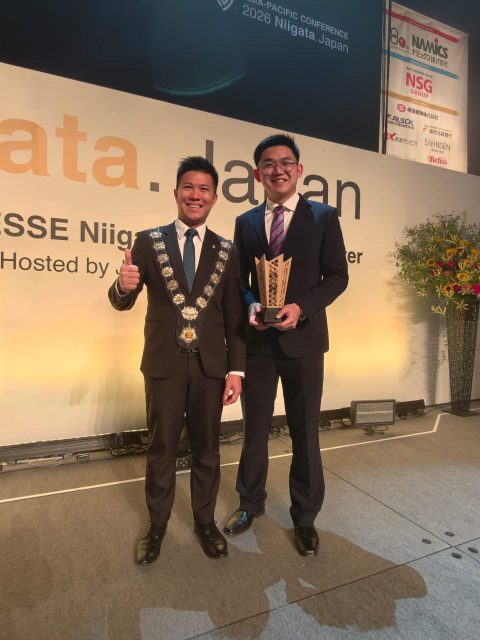
(Photo 4: Zhao Xiang holding his trophy alongside JCI Malaysia National President Vincent Leng)